Following is the text from IRS Notice 2011-44 regarding obtaining
retroactive reinstatement of tax-exempt status by showing that there was reasonable cause for late filing. My
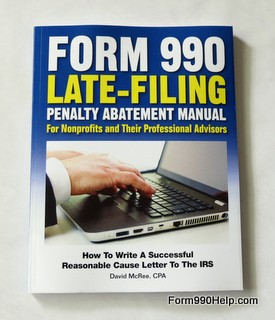
penalty relief manual e-book explains in detail how to make a reasonable cause argument and shows how to
actually implement the following IRS guidelines for the best chance of success.

Get my Penalty Relief Manual to
learn how to craft an effective reasonable cause argument to have your organization's tax-exempt status
retroactively reinstated.
SECTION 1. PURPOSE
This notice provides guidance with respect to applying for reinstatement of
tax-exempt status and requesting retroactive reinstatement under sections
6033(j)(2) and (3) of the Internal Revenue Code (“Code”) for an organization that
has had its tax-exempt status automatically revoked under section 6033(j)(1) of
the Code. The Treasury Department (“Treasury”) and the Internal Revenue
Service (“IRS”) intend to issue regulations under section 6033(j) that will
prescribe rules relating to the application for reinstatement of tax-exempt status
under section 6033(j)(2) and the request for retroactive reinstatement under
section 6033(j)(3). To assist in the drafting of these regulations, Treasury and
the IRS solicit comments on the issues addressed in this notice.
In this Bulletin, the IRS has also published Notice 2011-43, which provides
transitional relief for certain small organizations (those that normally have annual
gross receipts of not more than $50,000 in their most recently completed taxable
year) that have lost their tax-exempt status because they failed to file an annual
electronic notice for taxable years beginning in 2007, 2008, and 2009. Notice
2011-43 sets forth the criteria for qualifying for the transitional relief and
instructions on how qualifying organizations can apply for reinstatement of
tax-exempt status retroactive to the date such status was automatically revoked.
SECTION 2. BACKGROUND
In general, section 6033(a)(1) requires an organization exempt from taxation
under section 501(a) to file an annual information return, such as a Form 990,
Return of Organization Exempt from Income Tax,
a Form 990-EZ, Short Form
Return of Organization Exempt from Income Tax, or a Form 990-PF,
Return of
Private Foundation or Section 4947(a)(1) Nonexempt Charitable Trust Treated as
a Private Foundation. Several categories of tax-exempt organizations,
including
most organizations (other than private foundations or section 509(a)(3)
supporting organizations) whose annual gross receipts are normally not more
than $50,000 ($25,000 for taxable years beginning before January 1, 2010), are
not required to file an annual information return. See I.R.C. § 6033(a)(3); Rev.
Proc. 2011-15, 2011-3 I.R.B. 322.
The Pension Protection Act of 2006, Pub. L. No.109-280, 120 Stat. 780, §
1223 (2006) (“PPA”), added sections 6033(i) and (j) to the Code, both of which
became effective for taxable years beginning after 2006. Section 6033(i) added
an annual notification requirement for tax-exempt organizations that, pursuant to
section 6033(a)(3)(A)(ii) or (a)(3)(B), are not required to file an annual information
return under section 6033(a)(1) because their gross receipts fall below certain
thresholds. An organization satisfies the annual notification requirement under
section 6033(i) by filing an annual electronic notice, also known as a Form 990-N
e-Postcard. The annual notification requirement is also deemed satisfied if an
organization files a complete Form 990 or Form 990-EZ. See Treas. Reg. §
1.6033-6(c)(4).
Section 6033(j)(1) automatically revokes the tax-exempt status of any
organization described in section 6033(a)(1) that fails to file a required annual
return for three consecutive years or any organization described in section
6033(i) that fails to file an annual return or notice for three consecutive years.
Revocation under section 6033(j)(1) is effective on and after the date set by the
Secretary for the filing of the third annual return or notice.
Section 6033(j)(1) also requires the Secretary to publish and maintain a list of
all organizations that have had their tax-exempt statuses revoked under section
6033(j)(1) (“revocation list”). The IRS is publishing such a revocation list on the
IRS website (http://www.irs.gov), which it will update monthly. The IRS is
also
mailing a letter to the last known address of each organization on the revocation
list to notify the organization that its tax-exempt status has been revoked under
section 6033(j)(1) (“IRS revocation letter”).
Section 7428(b)(4), as added by the PPA, provides that an organization may
not bring a declaratory judgment action challenging automatic revocation under
section 6033(j)(1).
Section 6033(j)(2) provides that any organization that has had its tax-exempt
status automatically revoked under section 6033(j)(1) must apply with the IRS in
order to obtain reinstatement of its tax-exempt status, regardless of whether the
organization was originally required to apply for recognition of its tax exemption.
If the application for reinstatement of tax-exempt status is approved, the effective
date of the organization’s reinstated tax-exempt status generally will be the date
the organization filed its application for reinstatement. However, section
6033(j)(3) provides that if, upon application for reinstatement, an organization
“can show to the satisfaction of the Secretary evidence of reasonable cause for
the failure described in [section 6033(j)(1)], the organization’s exempt status
may, in the discretion of the Secretary, be reinstated effective from the date of
the revocation.”
SECTION 3. EFFECTIVE DATE OF AUTOMATIC REVOCATION
For taxable years beginning after December 31, 2006, the tax-exempt status
of any organization that fails to file an annual information return required under
section 6033(a)(1) or an electronic notice required under section 6033(i) for three
consecutive years is automatically revoked pursuant to section 6033(j)(1) on and
after the date set by regulation for the filing of the third annual return or notice,
without regard to any extension of time for filing. Sections 1.6033-2(e) and
1.6033-6(f) of the Treasury Regulations generally require annual returns and
notices, respectively, to be filed on or before the 15th day of the fifth month
following the close of the period for which the return or notice is required to be
filed. When the filing deadline falls on a Saturday, Sunday, or legal holiday the
deadline may be timely satisfied if the filing is made on the next business day
that is not a Saturday, Sunday, or a legal holiday. See I.R.C. § 7503. Thus, for
example, in the case of an organization reporting on a calendar-year basis that
did not file a required annual return or notice for 2007, 2008, or 2009, the
revocation under section 6033(j)(1) would be effective as of May 17, 2010, given
that May 15, 2010 fell on a Saturday.
SECTION 4. APPLICATION FOR REINSTATEMENT OF TAX-EXEMPT
STATUS
An organization seeking reinstatement of its tax-exempt status under section
6033(j)(2) must apply using the same forms that are filed by all other applicants
for tax exemption. Thus, an organization seeking reinstatement of its tax-exempt
status under section 501(c)(3) must submit Form 1023, Application
for
Recognition of Exemption Under Section 501(c)(3) of the Internal Revenue Code.
Most other organizations seeking reinstatement of tax-exempt status must
submit
Form 1024, Application for Recognition of Exemption Under Section
501(a). Any
organization that seeks reinstatement of its tax-exempt status must submit the
appropriate application regardless of whether the organization was originally
required to apply with the IRS for recognition of tax exemption. For example, if
the tax-exempt status of a subordinate organization included in a group
exemption letter is automatically revoked under section 6033(j)(1), the
subordinate organization must submit an application for reinstatement of its taxexempt
status on its own behalf. In addition, all organizations seeking
reinstatement of tax-exempt status must pay the appropriate user fee. See Rev.
Proc. 2011-8, 2011-1 I.R.B. 237, section 6.07 or its successor. (Small taxexempt
organizations described in Notice 2011-43 are eligible for a reduced user
fee described in Rev. Proc. 2011-36, this Bulletin.)
To facilitate processing of applications for reinstatement of tax-exempt status,
organizations should write “automatically revoked” on the top of the application
form and on the envelope. For information on where to mail the application for
reinstatement of tax-exempt status, see the Instructions for Form 1023 or Form
1024 (whichever is applicable).
SECTION 5. RETROACTIVE REINSTATEMENT
.01 Request for Retroactive Reinstatement
An organization (other than a small organization that qualifies for the
transitional relief described in Notice 2011-43) seeking to have its tax-exempt
status reinstated effective from the date of automatic revocation pursuant to
section 6033(j)(3) must submit a request for retroactive reinstatement with its
application for reinstatement of tax-exempt status. The request for retroactive
reinstatement must include the following:
(1) A written statement setting forth all of the facts that support its claim for
reasonable cause for failing to file a required return or notice in each of the three
consecutive years and over the entire consecutive three-year period, including a
detailed description of all the facts and circumstances that led to each failure and
the continuous failure, the discovery of the failures, and the steps taken to avoid
or mitigate the failures;
(2) A written statement describing the safeguards the organization has put
into place to ensure that the organization will not fail to file returns or notices in
the future;
(3) Evidence to substantiate all material aspects of the written statements
described in paragraphs (1) and (2) of this section;
(4) Properly completed and executed paper annual information returns
(Forms 990, Forms 990-EZ, or Forms 990-PF, whichever is applicable) for all
taxable years during and after the consecutive three-year period that the
organization was required, but failed, to file an annual information return;
(5) Properly completed and executed Forms 990-EZ for all taxable years
during and after the consecutive three-year period that the organization was
eligible to file a Form 990-N e-Postcard but failed to file either a Form 990-N e-
Postcard or an annual information return; and
(6) An original declaration, dated and signed under penalties of perjury by
an officer, director, trustee, or other official who is authorized to sign for the
organization in the following form:
I, ____________ (Name), ______________ (Title) declare,
under penalties of perjury, that I am authorized to sign this request
for retroactive reinstatement on behalf of [Name of Organization],
and I further declare that I have examined this request for
retroactive reinstatement, including the written explanation of all the
facts and information pertaining to the claim for reasonable cause
and the evidence to substantiate the claim for reasonable cause,
and to the best of my knowledge and belief, this request is true,
correct, and complete.
.02 Reasonable Cause Standard
Because the failure described in section 6033(j)(1) involves a repeated and
continuous failure to file annual returns or notices for a consecutive three-year
period, an organization seeking retroactive reinstatement under section
6033(j)(3) must demonstrate that it had reasonable cause for failing to file a
return or notice not only for each of the three years but also over the entire three8
year period. Thus, for example, showing reasonable cause for failing to file a
required return or notice for the first of the three years by the date it was due
would be insufficient; an organization also would have to show reasonable cause
for not filing that return or notice at any later time during the three-year period
and for not filing required returns or notices for the second and third years of the
three-year period.
In order to establish reasonable cause under section 6033(j)(3), an
organization requesting retroactive reinstatement must provide evidence that it
exercised ordinary business care and prudence in determining and attempting to
comply with its reporting requirements under section 6033 for each of the three
years and over the entire three-year period, but was nevertheless unable to file
the required returns or notices for three consecutive years. In determining
whether the organization establishes reasonable cause, the IRS will take into
account all pertinent facts and circumstances, including, but not limited to, the
following factors that weigh in favor of finding reasonable cause (with no single
factor being either necessary or determinative):
(1) The organization’s failure was due to its reasonable, good faith reliance
on erroneous written information from the IRS, stating that the organization was
not required to file a return or notice under section 6033, provided the IRS was
made aware of all relevant facts.
(2) The failure to file the returns or notices arose from events beyond the
organization’s control (“impediment”) that made it impossible for the organization
to file returns or notices for each of the three years at issue and over the entire
three-year period.
(3) The organization acted in a responsible manner by undertaking
significant steps to avoid or mitigate the failure to file the required returns or
notices and to prevent similar failures in the future, including, but not limited to--
(a) Attempting to prevent an impediment or a failure, if it was foreseeable;
(b) Acting as promptly as possible to remove an impediment or the cause
of the reporting failure, once the failure was discovered; and
(c) After the failure was discovered, implementing sufficient safeguards to
ensure future compliance with the reporting requirements under section 6033.
(4) Aside from the three consecutive years in which the organization failed to
file returns or notices, the organization has an established history of complying
with its reporting requirements (if any) under section 6033 and/or any other
applicable reporting or other requirements under the Code.
In determining whether reasonable cause exists, the IRS will only consider a
factor on the above list or any other factor (such as the fact that substantially all
of an organization’s activities are performed by volunteers) if the organization
shows to the satisfaction of the IRS evidence to substantiate the factor.
.03 Timing of Request for Retroactive Reinstatement
Except for small organizations that qualify for the transitional relief described
in Notice 2011-43, the IRS will, in exercising the discretion granted under section
6033(j)(3), consider an organization’s request for retroactive reinstatement only if
it submits such a request, together with a properly completed and executed
application for reinstatement of its tax-exempt status, within 15 months of the
later of the date of the IRS revocation letter or the date on which the IRS posts
the name of the organization on the revocation list available on the IRS website
(or otherwise provides notice of the revocation to the public).
SECTION 6. SUBSEQUENT AUTOMATIC REVOCATIONS
An organization whose tax-exempt status has been automatically revoked and
reinstated may have its tax-exempt status automatically revoked a second time
under section 6033(j)(1) only if it fails to file returns or notices for another three
consecutive taxable years, beginning with the taxable year the IRS approves its
application for reinstatement of tax-exempt status. For example, if an
organization reporting on a calendar year basis has its tax-exempt status
automatically revoked for failing to file required returns or notices for 2007, 2008,
and 2009 and receives a determination letter recognizing the reinstatement of its
tax-exempt status dated September 1, 2011, the organization’s tax-exempt
status will not be automatically revoked a second time for failing to timely file a
return or notice for 2008, 2009, and 2010. However, the organization’s taxexempt
status will be automatically revoked a second time if the organization fails
to timely file a return or notice for 2011, 2012, and 2013.
SECTION 7. PAPERWORK REDUCTION ACT
The collection of information contained in this notice has been submitted to
the Office of Management and Budget in accordance with the Paperwork
Reduction Act of 1995 (44 U.S.C. 3507(d)) and approved under OMB control
number 1545-2206.
The collection of information in this notice is in section 5. In order to have its
tax-exempt status retroactively reinstated under section 6033(j)(3), an
organization must show to the satisfaction of the IRS evidence that it exercised
ordinary business care and prudence in determining and attempting to comply
with its reporting obligations under section 6033 for each of the three years (and
over the entire three-year period) that it failed to meet such requirements. This
information is necessary for inspection by the IRS in determining whether
reasonable cause exists. The collection of information is required to meet the
reasonable cause standard under section 6033(j)(3). The likely respondents
providing the information required in section 5 of this notice are tax-exempt
organizations that have had their tax-exempt statuses automatically revoked
under section 6033(j)(1), have applied for reinstatement of such status under
section 6033(j)(2), and are seeking that such reinstatement be made retroactive
to the date of revocation under section 6033(j)(3).
Estimated total annual reporting burden: 2,917 hours.
Estimated average annual burden per respondent: 1 hour.
Estimated number of respondents over the next three years: 8,750.
Additional collection of information is proposed in section 4 of the notice,
which will be reported and approved through Forms 1023 and 1024 (OMB
approval numbers 1545-0056 and 1545-0057, respectively).
An agency may not conduct or sponsor, and a person is not required to
respond to, a collection of information unless it displays a valid control number
assigned by the Office of Management and Budget.
SECTION 8. REQUEST FOR COMMENTS
Treasury and the IRS request comments regarding this notice and
suggestions for future guidance regarding the provisions of section 6033(j).
Comments should be submitted on or before August 19, 2011. Please include
“Notice 2011-44” on the cover page. Comments should be sent to the following
address:
Internal Revenue Service
CC:PA:LPD:PR (Notice 2011-44), Room 5203
P.O. Box 7604
Ben Franklin Station
Washington, D.C. 20224.
Submissions may be hand delivered Monday through Friday between the
hours of 8 a.m. and 4 p.m. to:
Internal Revenue Service
Courier’s Desk,
1111 Constitution Avenue, N.W.
Washington, D.C. 20224
Attn: CC:PA:LPD:PR (Notice 2011-44)
Submissions may also be sent electronically to the following e-mail address:
Notice.Comments@irscounsel.treas.gov.
Please include “Notice 2011-44” in the subject line.
All comments will be available for public inspection and copying.
SECTION 9. DRAFTING INFORMATION
The principal authors of this notice are Monice Rosenbaum and Preston
Quesenberry of the Office of Division Counsel/Associate Chief Counsel (Tax
Exempt and Government Entities) and Matthew Giuliano of the Tax Exempt and
Government Entities Division of the IRS. However, other personnel from the IRS
and Treasury Department participated in developing this notice. For further
information regarding this notice, contact Ms. Rosenbaum at (202) 622-6070, Mr.
Quesenberry at (202) 622-1124, or Mr. Giuliano at (202) 283-8917 (not toll-free
numbers).
You can download Notice 2011-44 as a pdf file directly from the IRS web site.
|